
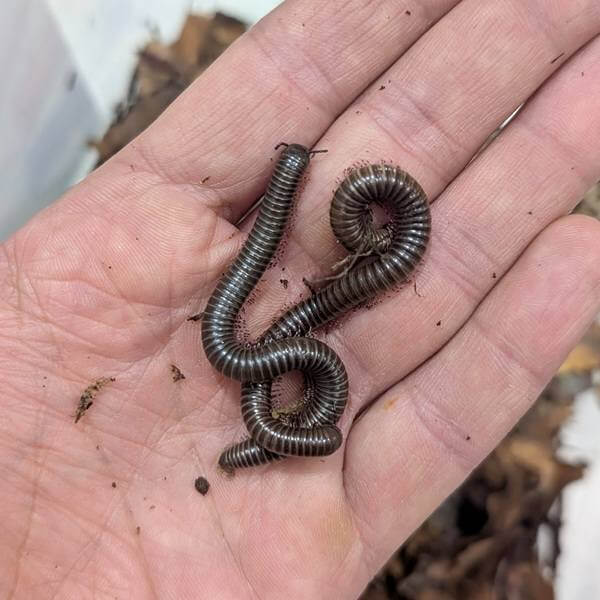
Product: Live specimen of Telodeinopus aoutii
Info: Sold individually
Origin: Africa
Food: Leaf litter, fruit, vegetables and suitable dry food
€9,90
In stock
The Telodeinopus aoutii, commonly known as the Giant African Olive Millipede or Ghana Speckled-leg Millipede, is an attractive African millipede prized for its elegant appearance, unusually long legs and active behaviour. Its slender body displays beautiful olive-green to brown tones, often with lighter and darker markings along the segments, while its long, striped legs give it a particularly distinctive look.
Native to West Africa, particularly Ghana and Togo, this species is an excellent choice for anyone interested in keeping large, active millipedes. Unlike many other species that spend most of their time hidden beneath the substrate, Telodeinopus aoutii is a good climber and frequently explores the branches, bark and other structures in its enclosure. This makes it especially enjoyable to observe.
Adults generally reach 16–20 cm in length, making this a medium-to-large millipede with a remarkably graceful appearance. It is considered relatively easy to maintain and can be a good choice for both beginners and experienced invertebrate enthusiasts, provided that its environmental requirements are met.
A suitable enclosure should provide enough floor space for movement as well as plenty of vertical structures for climbing. For an adult or a small group, a terrarium of approximately 50 × 30 cm of floor space is a useful starting point. A secure lid is essential, as this species is an active climber and may explore every part of its enclosure.
The substrate is one of the most important elements of the setup. It should be at least 10–15 cm deep and consist of a natural, organic mixture containing untreated soil, leaf litter, decomposed hardwood and humus. Decaying leaves and wood are not merely decorative: they provide essential nutrients and form the basis of the millipede’s diet.
Add pieces of cork bark, moss and other natural materials to create hiding places. It is particularly important to provide branches, sturdy twigs and pieces of bark arranged at different angles. Telodeinopus aoutii is an excellent climber and will regularly use these structures to explore its surroundings.
The substrate should remain consistently moist but never waterlogged. A moisture gradient is beneficial, allowing the animal to choose between slightly different microclimates within the enclosure.
A temperature range of approximately 22–28 °C is suitable for this species, with around 23–25 °C being a good target for routine maintenance. Avoid sudden temperature fluctuations and excessive heat.
Relative humidity should generally be maintained around 75–85%, while ensuring that the substrate remains moist at depth. Regular misting may be necessary depending on ventilation and room conditions.
Good ventilation is essential to prevent stagnant air, excessive condensation and mould growth. The aim is to maintain a humid environment without allowing the enclosure to become excessively wet.
Telodeinopus aoutii is a detritivore that feeds primarily on decomposing organic material. A constant supply of dry leaves and well-rotted hardwood should always be available in the enclosure.
Its diet can be supplemented with a variety of fresh foods, including:
A permanent source of calcium is also essential. Cuttlefish bone or a suitable calcium supplement can be provided to support the development and maintenance of a healthy exoskeleton.
Remove uneaten fresh food regularly to prevent spoilage and the development of mould.
One of the most appealing characteristics of Telodeinopus aoutii is its active behaviour. It frequently climbs branches and bark, making it more visible than many other millipedes. It is generally peaceful and can be maintained in small groups, provided that the enclosure offers sufficient space, food and hiding places.
This species can also be considered for carefully planned mixed invertebrate enclosures, although compatibility should never be assumed. Avoid overcrowding and ensure that all inhabitants have access to suitable food and shelter.
Like other millipedes, T. aoutii can release defensive secretions when stressed or handled. These substances may irritate the skin and eyes, so unnecessary handling should be avoided. Always wash your hands after contact and never touch your eyes or mucous membranes before doing so.
Breeding in captivity is achievable, and this species is considered relatively straightforward to reproduce under suitable conditions. Maintaining a stable environment, with a deep substrate rich in decomposing organic matter, is particularly important for successful reproduction.
Sexual maturity is generally reached at approximately 2–3 years of age. Females lay their eggs in the substrate, where the developing young remain protected. Juveniles require the same basic environmental conditions as adults, with particular attention to substrate quality, moisture and the continuous availability of decomposing leaves and wood.
Avoid disturbing the deeper substrate unnecessarily, as individuals may be moulting or developing underground.
With its olive-green colouration, exceptionally long legs and active climbing behaviour, Telodeinopus aoutii is a fascinating addition to a naturalistic terrarium. Its relatively straightforward care requirements and interesting behaviour make it an excellent species for anyone looking to discover the world of large African millipedes.
WhatsApp us