
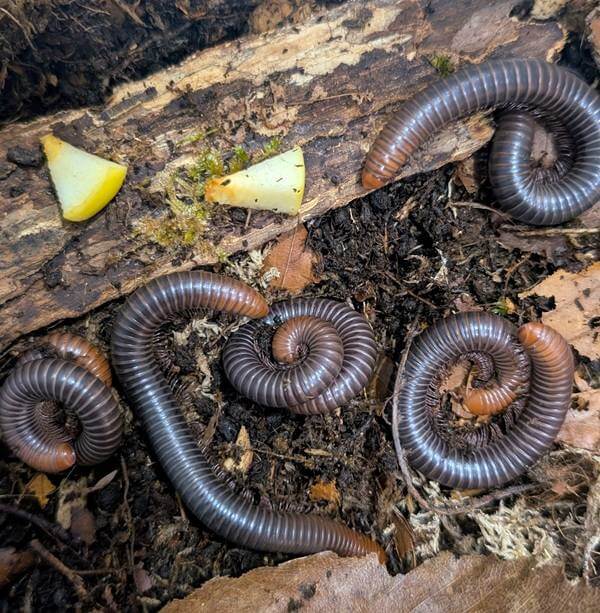
Product: Live specimen of Spirostreptus servatius
Info: Sold individually
Origin: Africa
Food: Leaf litter, fruit, vegetables and suitable dry food
€19,00
In stock
The Spirostreptus servatius, commonly known as the Firehead Millipede, is a large African millipede highly appreciated for its impressive size, peaceful behaviour and distinctive contrasting colours. Its dark body, usually black or olive-green, highlights the reddish colour of its head, which gives the species its common name.
This is an interesting species for anyone looking to keep a large millipede and observe the fascinating behaviour of these detritivores. Although primarily nocturnal, specimens may sometimes be seen during the day, moving across the substrate or exploring their enclosure.
Reaching approximately 20–26 cm in length, Spirostreptus servatius is an impressive invertebrate. Its care is not particularly demanding, but special attention must be paid to the quality and depth of the substrate. This is not simply the flooring of the enclosure: it is an essential part of the animal’s diet and provides the environment in which the millipede spends much of its life.
To keep Spirostreptus servatius successfully, provide a terrarium with a suitable floor area and, above all, a deep substrate. Adults can reach considerable dimensions and need enough space to move around and burrow.
The substrate should be at least 10–15 cm deep, preferably deeper if the enclosure allows it. Use a natural mixture rich in organic matter, consisting of untreated soil, leaf humus, well-rotted hardwood and dry leaves. Decaying wood and leaf litter are essential components of this millipede’s diet.
Moss and pieces of bark can be added to create hiding places and help retain moisture. Branches and bark also provide environmental enrichment, as these millipedes may occasionally climb.
The substrate should remain moist but never waterlogged or saturated. Ideally, maintain different moisture levels in different areas of the enclosure, allowing the millipede to choose the microhabitat that best suits its needs.
A suitable temperature range is approximately 22–28 °C, with temperatures around 25–26 °C being appropriate for everyday maintenance. Avoid sudden temperature fluctuations and excessive heat, particularly in poorly ventilated enclosures.
Relative humidity can be maintained at approximately 70–80%. Rather than relying exclusively on a precise hygrometer reading, regularly check the condition of the substrate: it should retain good moisture at depth without becoming waterlogged.
Adequate ventilation is essential to prevent excessive mould growth and stagnant moisture. A surface layer of leaves, bark and moss can also help slow evaporation.
Spirostreptus servatius is a detritivore that primarily feeds on decomposing plant matter. Its diet should consist mainly of dry leaves and decaying wood, which should always be available in sufficient quantities throughout the terrarium.
Small amounts of fruit and vegetables can be offered as supplements, such as courgette, carrot, cucumber and apple. Suitable protein sources may occasionally be provided, but they should never become the main component of the diet.
A permanent calcium source is essential. Cuttlefish bone or a suitable calcium supplement can be provided to support proper exoskeleton development.
Remove uneaten fresh food before it begins to decompose excessively.
This is generally a peaceful species that can also be kept in small groups, provided that there is enough space and substrate for all individuals. Cohabitation with other millipedes or compatible isopods may also be considered, while avoiding overcrowding and competition for resources.
Like other millipedes, S. servatius may release irritating defensive secretions when disturbed or handled. Handling should therefore be kept to a minimum. Always wash your hands thoroughly after contact and avoid touching your eyes or mucous membranes. These secretions can cause irritation, particularly if they come into contact with the eyes or damaged skin.
Breeding in captivity is possible, although obtaining consistent results can be challenging. As with other large millipedes, growth is relatively slow, and individuals undergo several moults before reaching sexual maturity.
A deep, stable substrate rich in organic matter is particularly important for encouraging natural reproductive behaviour and providing females with a suitable environment for egg-laying. Avoid disturbing the deeper substrate unnecessarily, as individuals may be moulting or developing underground.
Thanks to its impressive size, distinctive colouration and relatively straightforward care requirements, Spirostreptus servatius is an interesting choice for millipede and exotic invertebrate enthusiasts. An intriguing species to observe, perfect for a naturalistic forest-floor terrarium and for discovering the ecological role of large detritivores.
WhatsApp us