

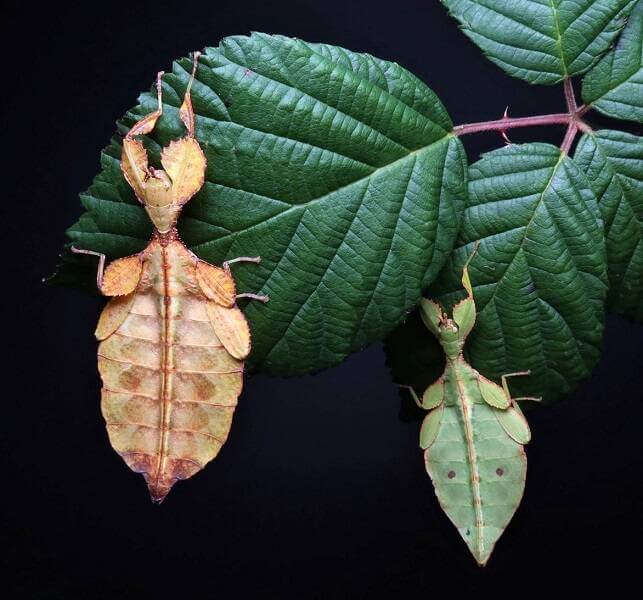
Product: Live eggs of Phyllium letiranti
Info: Packs of 30 eggs each
Origin: “Peleng island” Sulawesi, Indonesia
Host Plants: Rubus, Eucalyptus, Rosa, Quercus and others
Hatching time: 2-3 months
€16,00
In stock
Phyllium letiranti, also known as Le Tirant’s Walking Leaf, is a remarkable leaf insect belonging to the family Phylliidae, endemic to Peleng Island, Indonesia. Described in 2018, this fascinating species is particularly appreciated by phasmid enthusiasts for its impressive size and extraordinary colour variation, especially among females. The captive-bred population known as “Tataba” originates from the village of Tataba, on Peleng Island.
One of the most fascinating features of Phyllium letiranti is the remarkable diversity of female colouration. Unlike many other leaf insects, whose adults are predominantly green, females of this species can display an astonishing range of colours, including bright green, greenish-brown, dark brown, yellow and even vivid orange. Some individuals also exhibit beautiful combinations of these colours, making every specimen potentially different. Males, on the other hand, are generally more consistent in appearance and are predominantly green.
Females are particularly impressive in size, reaching approximately 8.5–9.5 cm in body length, while males can grow to around 7 cm. This makes Phyllium letiranti considerably larger than the commonly bred Phyllium philippinicum, offering an especially attractive alternative for collectors interested in large and unusual leaf insects.
This listing includes 30 Phyllium letiranti eggs, providing an excellent opportunity to breed this spectacular species and discover the fascinating colour variations that develop as the insects mature.
Phyllium letiranti is considered a relatively easy species to breed and maintain, making it suitable for both experienced phasmid keepers and enthusiasts approaching leaf insects for the first time. Another particularly appealing characteristic is its remarkable longevity. Females can live for approximately eight months after reaching adulthood, continuing to mate and lay eggs throughout much of their adult life. Combined with their relatively long juvenile development, this makes the species especially rewarding to keep over an extended period.
The eggs are approximately 5 mm long and 3 mm wide, with a distinctive structure featuring small lateral fringes. When freshly laid, they are orange-brown, gradually becoming lighter and straw-brown after exposure to moisture. Incubation generally takes around 4–5 months at temperatures of 20–24°C, although this period can vary depending on environmental conditions. The cup incubation method, using moderately moist vermiculite, works particularly well. Eggs can also be lightly covered with a thin layer of vermiculite to help newly hatched nymphs emerge successfully.
Newly hatched nymphs measure approximately 14 mm and display a dark brown colouration with light greenish-yellow markings. As they develop through successive moults, their appearance becomes increasingly variable. Older female nymphs can develop green, brown, greenish-brown or yellowish colouration, while males generally retain their characteristic green appearance.
For feeding, bramble (Rubus spp.) is an excellent and widely accepted foodplant for both nymphs and adults. Salal (Gaultheria shallon) is another very suitable alternative, while guava (Psidium guajava) and mango (Mangifera indica) have also been recorded as foodplants in the natural habitat.
A relative humidity of approximately 65–70% is generally sufficient for successful development. Light misting two or three times per week with chlorine-free water is usually adequate, allowing the enclosure to dry between applications. Good ventilation is important to prevent excessive moisture and mould.
Small nymphs can initially be kept in appropriately sized containers, preferably with good access to fresh foodplants. As they grow, they should be transferred to larger enclosures with sufficient vertical space for normal development and successful moulting. At 20–24°C, males generally reach adulthood after approximately 4–5 months, while females require around 5–6 months.
Unlike several other leaf insect species, Phyllium letiranti shows relatively little behavioural cannibalism, making it easier to maintain a healthy breeding colony.
With its impressive dimensions, exceptional colour diversity, long adult lifespan and relatively straightforward breeding requirements, Phyllium letiranti “Tataba” is undoubtedly one of the most rewarding and visually interesting leaf insects to keep.
WhatsApp us