
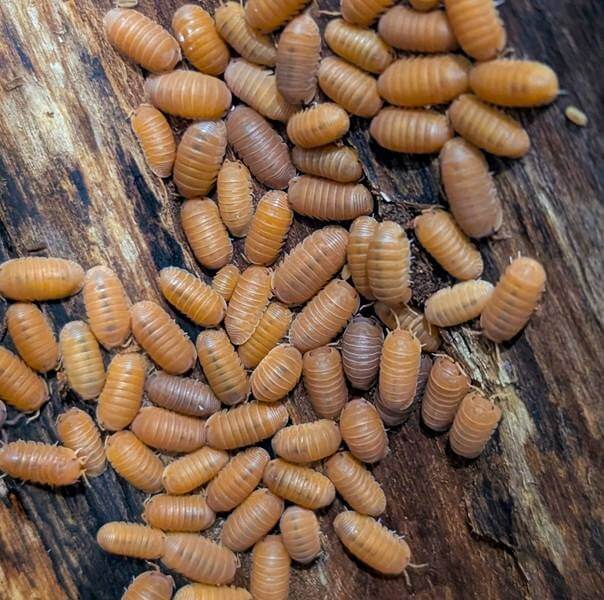
Product: Live specimens of Cubaris murina “Mandarin”
Info: pack of 10 large specimens
Origin: South-East Asia
Food: Leaf littr, fruit, vegetables and suitable dry food
€22,00 Original price was: €22,00.€20,00Current price is: €20,00.
In stock
Discover Cubaris murina “Mandarin”, one of the most appreciated isopods among invertebrate enthusiasts and bioactive terrarium keepers. This attractive variety is characterised by its beautiful orange colouration, reminiscent of a ripe mandarin orange. It is an excellent choice for anyone looking to keep colourful tropical isopods, observe the fascinating behaviour of a colony and enjoy watching it reproduce and grow over time.
The Mandarin morph stands out for its warm orange tones, which can range from deep orange to lighter shades, creating an attractive contrast against dark substrate, dried leaves and moss. Its body is compact and rounded, with the characteristic ability to roll into a complete ball when disturbed, a defensive behaviour known as conglobation.
This package contains 10 large Cubaris murina “Mandarin” specimens, an ideal number for establishing a new colony. Starting with a group of this size gives the animals a good opportunity to settle in, reproduce and gradually establish a thriving population when provided with suitable environmental conditions and a balanced diet.
Cubaris murina belongs to the family Armadillidae and is a terrestrial isopod species. The name Mandarin refers to a particular colour morph selected and bred in captivity, rather than a separate biological species.
Compared with some of the more delicate and demanding Cubaris varieties available in the ornamental isopod hobby, this morph is generally considered hardy, adaptable and relatively easy to keep. It is therefore an interesting choice for beginners who want to explore the genus Cubaris without compromising on striking colouration.
Like other terrestrial isopods, Cubaris murina plays an important ecological role in the decomposition of organic matter. It primarily feeds on dead leaves and decaying wood, helping recycle nutrients within the substrate. For this reason, it can also be kept in naturalistic and bioactive terrariums, where it contributes to the breakdown of organic waste.
The species is predominantly crepuscular and nocturnal. During the day, individuals tend to hide beneath bark, leaves and moss, while during darker hours they become more active and can be observed searching for food.
To establish a Cubaris murina Mandarin colony, you can use a plastic container with a lid and adequate ventilation or a small dedicated isopod terrarium. For the initial group of 10 specimens, a surface area of at least 20 × 20 cm is recommended, allowing sufficient room for the colony to grow.
The substrate should be organic, loose and capable of retaining moisture without becoming compacted or waterlogged. A depth of approximately 6–8 cm is a good starting point. Always use natural materials free from pesticides, fertilisers and other chemical treatments.
The main components of the enclosure should include dried broadleaf litter, decaying hardwood and well-decomposed organic matter. Sphagnum moss can also be added to improve moisture retention and create a particularly humid refuge.
Add pieces of cork bark, decaying wood and a generous layer of dried leaves on the surface. These elements provide hiding places and additional feeding surfaces, helping recreate the conditions of a natural forest floor.
One of the most important aspects of keeping this species successfully is maintaining a good balance between humidity and air circulation.
The substrate should remain moderately moist but never waterlogged. It is advisable to maintain one section of the enclosure at a higher moisture level, possibly using sphagnum moss, while allowing the opposite side to remain drier and better ventilated. This creates a moisture gradient that allows the isopods to choose the conditions that best suit their needs.
Mist or add water directly to the moist section when necessary, regularly checking the condition of the substrate. Avoid standing water, persistent condensation and insufficient ventilation, as excessively wet conditions can encourage mould growth and unwanted infestations.
Cubaris murina Mandarin prefers moderate tropical or subtropical temperatures. A range of 21–26 °C is particularly suitable for maintaining an active colony and encouraging reproduction.
Avoid significant temperature fluctuations and excessively high temperatures, especially when combined with poor air circulation. Heating equipment is generally unnecessary if the enclosure is kept in a room with suitable ambient temperatures.
The diet should be varied, although decomposing plant matter remains its most important component. Dried leaves should always be available and represent one of the colony’s main food sources.
You can supplement their diet with:
Calcium sources should always be available, as this mineral is essential for exoskeleton formation and successful moulting. Uneaten fresh food should be removed within 24–48 hours to prevent the accumulation of organic waste that could encourage mould and mites.
One of the main advantages of Cubaris murina Mandarin is its good reproductive potential in captivity. When maintained in a stable environment with sufficient food, calcium and humid hiding places, the colony can reproduce regularly and gradually increase in population.
As with other terrestrial isopods, the female carries her eggs and developing embryos inside a specialised ventral structure called a marsupium. Once development is complete, tiny juveniles known as mancae emerge and continue growing through successive moults.
There is no need to intervene directly during reproduction. The best approach is to maintain stable environmental conditions, provide plenty of organic material and avoid unnecessary disturbance. Over time, a well-established colony can become increasingly numerous.
The combination of striking orange colouration, interesting behaviour and relatively straightforward care makes this morph an excellent choice for ornamental isopod enthusiasts.
The package of 10 large specimens represents an excellent starter group for anyone wishing to establish their own colony without starting with only a handful of individuals. It is an interesting option for both beginners and experienced keepers looking to add a new colour morph to their collection.
WhatsApp us