
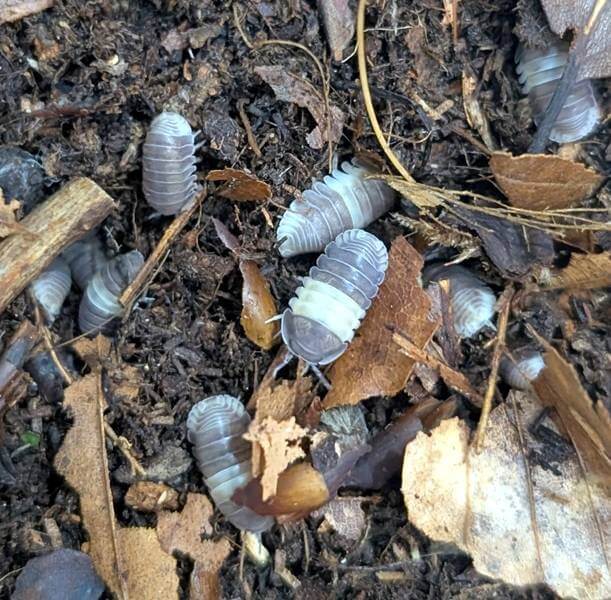
Product: Live specimens of Cubaris sp. “Panda King”
Info: pack of 10 large specimens
Origin: South-East Asia
Food: Leaf littr, fruit, vegetables and suitable dry food
€17,50 Original price was: €17,50.€15,00Current price is: €15,00.
In stock
Discover Cubaris sp. “Panda King”, one of the most recognisable and sought-after isopods in the world of ornamental invertebrate keeping. Famous for its striking black-and-white colouration, reminiscent of the giant panda, this fascinating terrestrial isopod is an excellent addition to any isopod collection and a rewarding species to breed in a dedicated enclosure.
The Panda King stands out thanks to its distinctive contrasting pattern: a dark charcoal to almost black body interrupted by a broad, pale white or creamy band across the middle segments. Its compact, rounded body and characteristic ability to roll into a ball when disturbed make it particularly fascinating to observe. This defensive behaviour, known as conglobation, is typical of several terrestrial isopods.
The package contains 10 Cubaris sp. “Panda King” specimens, a suitable starter group for establishing a new colony. With stable environmental conditions, appropriate nutrition and sufficient hiding places, these isopods can gradually settle in and reproduce, allowing the colony to develop over time.
Cubaris sp. “Panda King” is an ornamental isopod belonging to the family Armadillidae. Unlike formally described species, its scientific identity has not been definitively established, and Panda King is the commonly used name within the international isopod hobby.
Its most distinctive feature is undoubtedly its black-and-white colouration, which gives it the appearance of a miniature panda. Individual specimens may display variations in the intensity and distribution of their pale markings, making each animal slightly different.
Native to the tropical environments associated with Southeast Asia in the isopod trade, Panda King is generally kept under warm, humid conditions. It is a terrestrial crustacean that plays an important ecological role as a detritivore, feeding on decomposing leaves, decaying wood and other organic material.
Compared with many common isopods, Cubaris species generally require more stable humidity and carefully managed ventilation. Panda King is nevertheless considered one of the more approachable ornamental Cubaris varieties, making it an interesting choice for keepers who already have some experience with terrestrial isopods.
Like other members of its group, it is predominantly active in low-light conditions. During the day, individuals often remain hidden beneath cork bark, leaves and other refuges, becoming more visible when searching for food.
For a group of 10 Cubaris sp. “Panda King”, a plastic enclosure with a secure lid and carefully controlled ventilation is an excellent choice. Plastic containers are particularly useful because they retain humidity more effectively than many open glass terrariums.
A starting enclosure measuring approximately 20 × 20 cm or larger provides a suitable amount of space for a small colony. As the population increases, the enclosure can be upgraded accordingly.
The substrate is particularly important for this species. It should be organic, moisture-retentive and rich in edible material. A depth of at least 6 cm is recommended, allowing the isopods to burrow, hide and establish suitable microclimates.
A good substrate mix can include:
Cork bark, pieces of decaying hardwood and dried leaves should also be provided on the surface. These materials offer essential hiding places and additional feeding areas.
Maintaining stable humidity is one of the most important aspects of successful Panda King husbandry.
An approximate relative humidity of 75–85% is a useful target, although the condition of the substrate is more important than relying exclusively on a hygrometer reading.
The substrate should remain consistently moist, particularly in its lower layers, without becoming waterlogged. A moisture gradient should be established, with one side of the enclosure kept noticeably wetter and the opposite side slightly drier.
A small area of damp sphagnum moss works particularly well as a moisture reservoir. The isopods can use this area as a refuge, especially during moulting and reproduction.
Ventilation should be controlled rather than excessive. A few small ventilation openings are generally sufficient to maintain air exchange while preventing the enclosure from drying out too quickly. Completely stagnant air should also be avoided, as it can encourage mould and other unwanted microorganisms.
Check the substrate regularly and add water to the moist section whenever necessary. Avoid excessive misting and persistent condensation.
Cubaris sp. “Panda King” thrives in warm, stable conditions. A temperature range of 21–27 °C is generally suitable, with approximately 22–26 °C being a particularly good target for routine maintenance.
Sudden temperature fluctuations and prolonged exposure to excessive heat should be avoided. High temperatures combined with saturated substrate and poor ventilation can be particularly harmful.
In most indoor environments, additional heating is unnecessary. If heating is required, it should be carefully controlled using a thermostat, preferably warming only one side of the enclosure to preserve a cooler retreat.
Panda King isopods are detritivores, meaning that their natural diet consists primarily of decomposing organic material. A permanent supply of dried leaves and decaying hardwood should form the foundation of their diet.
To maintain a healthy and well-nourished colony, their diet can be supplemented with a variety of foods:
Calcium is particularly important because it contributes to the formation and maintenance of the exoskeleton. A permanent calcium source, such as cuttlebone, should always be available inside the enclosure.
Supplementary food should be offered in small quantities, generally once or twice a week depending on colony size and consumption. Remove uneaten fresh food within 24–48 hours to prevent mould and unwanted pest proliferation.
Cubaris sp. “Panda King” can reproduce successfully in captivity when environmental conditions are stable and nutritional requirements are met.
Like other terrestrial isopods, females carry developing embryos inside a specialised ventral brood pouch called a marsupium. Once development is complete, tiny juveniles known as mancae emerge and gradually develop their characteristic black-and-white colouration through successive moults.
Reproduction is not instantaneous, and newly established colonies may require some time to settle before the first juveniles become visible. Avoid repeatedly disturbing the substrate or moving the animals unnecessarily, as stable conditions are particularly important during this period.
Providing abundant leaf litter, decaying wood, calcium and humid refuges will help support the development of a healthy breeding population.
As the colony grows, the enclosure can be gradually expanded to provide sufficient space and food for the increasing number of individuals.
With its unmistakable panda-like appearance, compact body and interesting behaviour, Cubaris sp. “Panda King” is an excellent choice for enthusiasts looking to expand their collection with one of the most recognisable ornamental isopods.
Its contrasting black-and-white markings make it particularly attractive in naturalistic terrariums, while its burrowing and social behaviour offer plenty of opportunities for observation.
The package of 10 specimens provides a suitable starting group for anyone wishing to establish their own Panda King colony. Whether you are an experienced isopod keeper or looking to take the next step in the hobby, this fascinating Cubaris is a rewarding addition to any collection.
WhatsApp us