
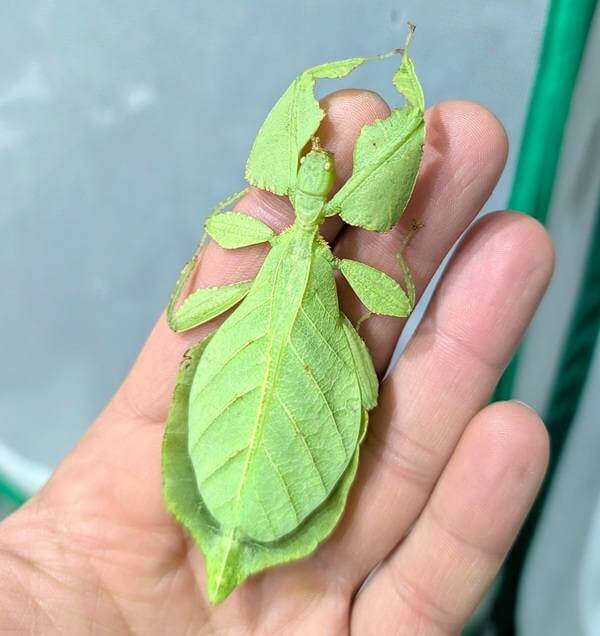
Product: Live eggs of Cryptophyllium oyae
Info: Packs of 25 eggs each
Origin: Laos
Host Plants: Rubus, Guava, Mango
Hatching time: 2-3 months
€15,00
In stock
Cryptophyllium oyae, commonly known as Oya’s Walking Leaf, is a spectacular leaf insect belonging to the family Phylliidae, native to Laos. This population originates from the area of Ban Saleuy, a village near Xam Nuea, in Houaphan Province, northeastern Laos. The species was scientifically described in 2020 and is particularly remarkable for its impressive size, intense green colouration and extraordinary leaf-like camouflage.
Females can reach approximately 8.5–10 cm in body length, while males are also remarkably large, measuring around 8–8.5 cm. Both sexes display beautiful green colouration, with their broad, flattened bodies and leaf-shaped legs creating an incredibly convincing resemblance to fresh foliage. The intricate camouflage pattern, combined with their natural posture and movements, makes them one of the most fascinating examples of mimicry among stick and leaf insects.
This listing includes 25 Cryptophyllium oyae “Ban Saleuy” eggs, offering the opportunity to raise this impressive species from the very beginning of its life cycle.
Cryptophyllium oyae is considered an easy-to-breed leaf insect species, making it an excellent choice for both experienced phasmid keepers and enthusiasts looking to start breeding Phylliidae. Both nymphs and adults are often active feeders during daylight hours, making them particularly enjoyable to observe.
Eggs are brown and measure approximately 4.5 × 2.5 mm. They can be incubated on moderately moist vermiculite using the cup incubation method. At temperatures of around 20–24°C, hatching generally takes approximately 4–6 months, although incubation time is strongly influenced by temperature. It is also normal for eggs from the same batch to hatch at different times, sometimes with several weeks or even months between the first and last hatchlings.
Newly emerged nymphs are approximately 14 mm long and display a distinctive reddish-brown colouration with small white markings, quite different from the bright green appearance of adults. As they grow and moult, they gradually develop their characteristic leaf-like shape and colouration.
For feeding, bramble (Rubus spp.) is an excellent and widely accepted foodplant for both nymphs and adults. Other suitable alternatives include Salal (Gaultheria shallon), mango (Mangifera indica) and guava (Psidium guajava).
A humidity level of approximately 65–70% is generally sufficient for successful nymph development and moulting, while adults, particularly males, benefit from slightly higher humidity. Light misting two or three times per week with chlorine-free water is usually sufficient, allowing the enclosure to dry between applications. Good ventilation is essential to prevent excessive moisture and mould growth.
Nymphs can initially be housed in appropriately sized smaller enclosures, but should be transferred to larger cages as they grow. Adult specimens require sufficient vertical space and good ventilation to allow normal movement and successful moulting. At 20–24°C, males typically reach adulthood in approximately 4–5 months, while females generally require 5–6 months.
As with other leaf insects, it is advisable to avoid overcrowding and provide enough space for all individuals. Although this species is not particularly prone to behavioural cannibalism, maintaining reasonable stocking densities helps ensure a healthy and successful breeding colony.
Cryptophyllium oyae “Ban Saleuy” is an outstanding species for anyone interested in leaf insects: large, intensely green, remarkably well camouflaged and relatively easy to rear. A fantastic addition to any phasmid collection!
WhatsApp us