
Travelling butterfly exhibition: when tropical butterflies come to town
By Giacomo Viola, biologist and founder of Time to Breed
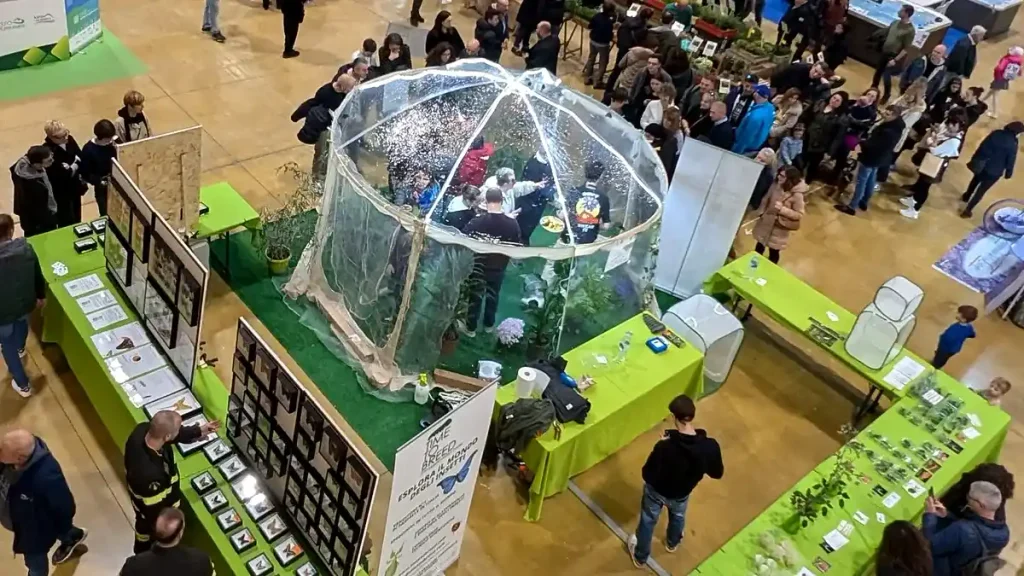
A door opens, then a second one. The air changes: it is warm, humid, scented with flowers. And suddenly, all around you, something moves. A flash of metallic blue passes a hand’s width from your face, a butterfly as large as your palm settles on a leaf, another chooses the shoulder of a child who holds their breath so as not to frighten it away. Welcome to a travelling butterfly exhibition: a piece of tropical rainforest that, for a few days, arrives at the heart of a fair, a festival or a town square.
It is an experience that is hard to describe and impossible to forget. You don’t look at it from behind glass: you walk through it. And everyone who steps inside, whatever their age, comes out with the same expression, the look of someone who has just seen something extraordinary.
What is a travelling butterfly exhibition?
A butterfly house is a protected space where tropical butterflies fly freely among flowering plants and feeding stations, while visitors walk among them. Many are permanent, in parks, museums and botanical gardens. A travelling butterfly exhibition does something different: it moves.
It is set up wherever it is needed, for the length of an event, and recreates inside the warm, humid climate that tropical butterflies need. Visitors enter in small groups through a double door that keeps the butterflies in, guided by the people who breed and care for them. For a few minutes, the noise of the fair stays outside, and all that remains are the colours, the beating of wings and the surprise.
In this way, an experience that usually requires a trip to a dedicated venue becomes a true mobile butterfly house, open to everyone in the places where people live and meet.
A wonder for every age
Anyone who works in a butterfly house soon learns to recognise a particular moment: the one when a visitor stops talking. It almost always happens in the first few seconds, when their eyes try to follow one butterfly and find ten in front of them.
Children are the first to be won over. They stand perfectly still with an arm outstretched, hoping a butterfly will choose them, and when it does, they tell everyone. But they are not the only ones. Parents, grandparents and teenagers who were “just passing by” slow down, take photos, ask questions. Many come back at the end of the day for a second visit, often with a friend.
This is the real strength of a butterfly house: it is not a show you watch, it is an encounter. Every visit is different, because the butterflies decide where to land. And for many people, it is the first time they have seen a wild animal so fragile, so colourful and so free up close.
The stars of the show: tropical butterflies from around the world
The butterflies that fly in our exhibition come mainly from the tropical forests of Central and South America, but also from Africa and Asia. Each one has a story to tell.
There is the Morpho, the blue butterfly everyone remembers. Its colour does not come from pigment but from the microscopic structure of the scales on its wings, which reflect light: that is why, depending on the angle, it shifts from electric blue to brown almost in an instant. There is the Caligo, the “owl butterfly”, whose underwings carry two large spots that look like the eyes of a bird of prey, a trick to scare off predators. And there is Siproeta stelenes, known as the “malachite” for the bright green of its wings, crossed by dark bands like the stone it is named after: when light shines through them, they look like tiny stained-glass windows in flight.
Then there are the details nobody expects. Butterflies, for example, can taste through their feet: when they land on a flower, or on a visitor’s hand, they are in a sense “tasting” it. A single fact like this is enough to turn a visit into a small biology lesson, without anyone noticing.
From chrysalis to first flight
A butterfly house also tells the story of metamorphosis, one of the most fascinating processes in nature. Next to the exhibition, at our stand, visitors can take a close look at the chrysalises: small hanging cases, often gold or green, inside which a caterpillar is completely transforming itself. With a little luck, you can witness the moment a butterfly emerges, unfolds its still-damp wings and, shortly afterwards, takes its first flight.
It is the simplest and most powerful way to show a child, and remind an adult, just how extraordinary the world of insects is. To find out more, read our guide to breeding butterflies.
An idea that wins audiences all over the world
Butterfly houses are not a passing trend. In London, the London Butterfly House welcomed visitors from 1981 to 2007, and since then similar venues have opened all over Europe. In Montréal, the botanical garden has held its large exhibition of free-flying butterflies every year since 1997, returning faithfully each spring. In Italy, Rome and Trento devote whole spring seasons to tropical butterflies, and in Cervia a butterfly house has been welcoming families and schools for years.
In recent years, however, something new has happened: the butterfly house has started to travel. In Central Europe, live butterfly exhibitions tour shopping centres. In Italy, more and more towns bring them to their main squares, often with the support of the local council and with tours designed for local schools.
The reason is simple. A butterfly house brings together three things that rarely go hand in hand: wonder, nature and knowledge. It appeals to children and adults alike, creates a moment worth sharing and leaves people with more than just entertainment. For a fair or a festival, it is an attraction that stands out, and one people talk about before, during and after the event.
Where we have taken our live butterfly exhibition
In recent years we have brought our tropical butterflies to some of the most popular events in Northern Italy, in front of very different audiences: families on a day out, visitors to agricultural fairs, curious passers-by. Every time, the same scene unfolds: a queue at the entrance, children gazing upwards, phones raised to photograph a butterfly resting on someone’s hand.
Agrivarese, Varese
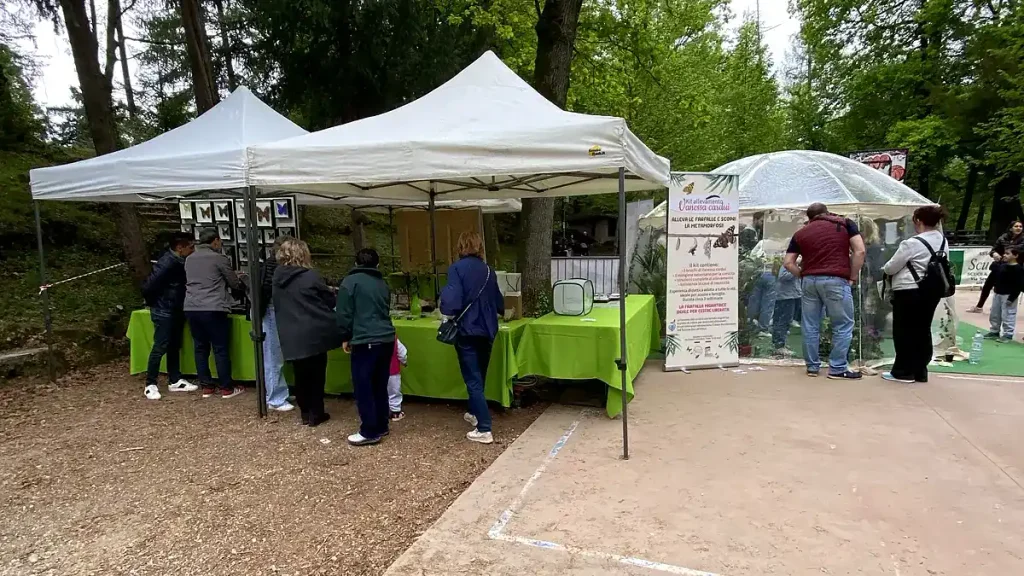
Agrivarese brings the farming and nature of the province of Varese into the city, in the Giardini Estensi, the historic gardens in the centre of town. Alongside farm animals and local produce, our tropical butterfly experience has become one of the attractions families look forward to most, for two editions now. The fact that the organisers invited us back after the first is the clearest sign that the format works.
Fiera di Sant’Abbondio, Como
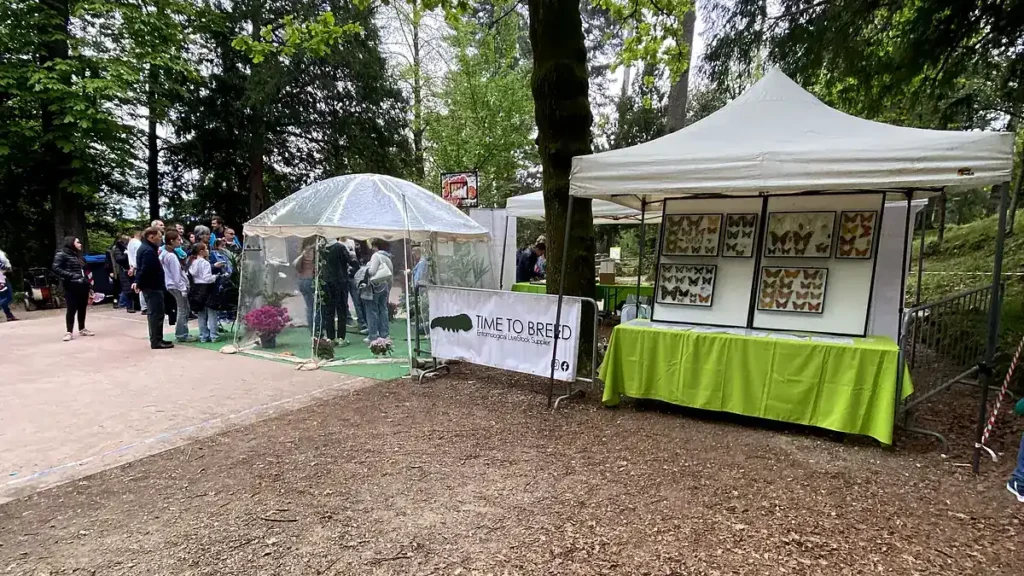
The Fiera di Sant’Abbondio is Como’s patron saint festival and one of the city’s most deeply rooted traditions. At the August 2026 edition, which ran for five days for the first time, our butterflies welcomed visitors among the market stalls, the local Lake Como cuisine and the family activities. A busy city setting that showed how the experience captivates even those who came to the fair for something else entirely.
Fiera Agricola Nazionale di Oleggio
On 1 May 2026, the historic agricultural fair of Oleggio, near Novara, became a national event for the first time, with exhibitors from several Italian regions. On a day dedicated to livestock farming and rural tradition, the butterfly house offered visitors a different kind of encounter with the animal world: smaller, more delicate and just as surprising.
And many more town squares
Beyond these events, our exhibition has been part of many other fairs, village festivals and town events. Different settings, the same reaction: when people walk out, the first question is almost always the same: “Will you be back next year?”
Want to know how it works and what you need to host one? Find out how to bring the butterfly house to your event.
When butterflies become art: “Freedom” at Varese Design Week
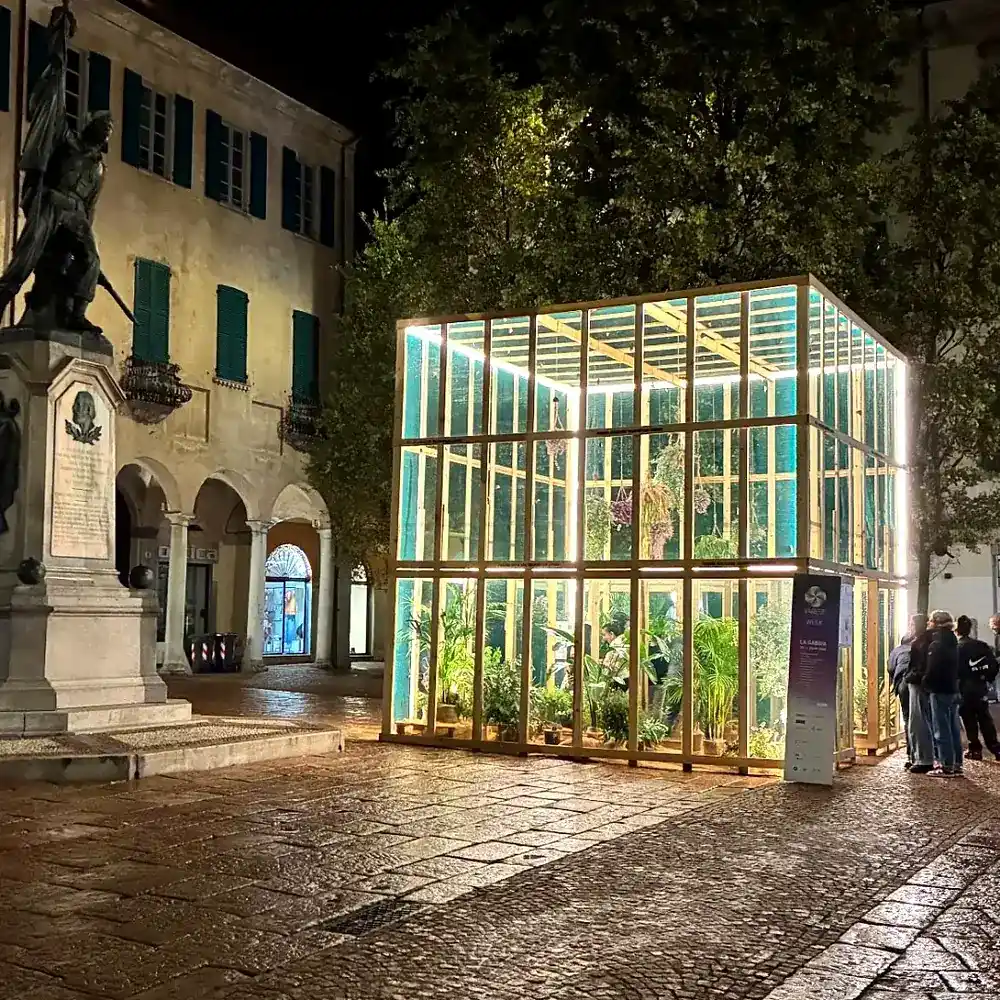
Then there is a project that stands slightly apart, because it was not created as an experience to walk through, but as a work of art to look at. In September 2025, the ninth edition of Varese Design Week had a very specific theme: the cage. In Piazza del Podestà, together with Novello Case, Fogliani Illuminazione and Floricoltura Bruschi, we created “Freedom“: a large wooden cube, five metres by five, home to almost two hundred tropical butterflies.
The idea was to turn the meaning of the cage upside down. No longer a place of confinement, but one of protection: a space designed for the butterflies, with all the plants they need to complete their life cycle. At sunset, thanks to warm lighting created for the occasion, the structure became a glowing lantern in the middle of the square, with the wings of Morpho, Caligo and Kallima butterflies moving behind its walls.
Visitors could not go inside, but they lingered around the installation for a long time. “Freedom” showed that live butterflies can also speak the language of design and contemporary art, and that their appeal reaches far beyond fairs and family events.
Behind the wonder: care, ethics and knowledge
An experience like this only makes sense if it respects the animals. That is why every butterfly house we bring to an event is the result of work the public never sees.
Our butterflies come from breeding farms, not from the wild. In many tropical countries, such as Costa Rica and Indonesia, butterfly farming provides an income for local communities, often for women, and gives real value to protecting the forests. Inside the exhibition, temperature, humidity, plants and feeding are carefully managed throughout the event, and our staff guide visitors on how to behave: move slowly, never grab the butterflies, let them choose where to land.
At the end of the event, the butterflies are not released. They are tropical species, not suited to European climates and not native to our environments: they remain in our care. It is a simple rule, but it is what separates a serious experience from a mere attraction.
About us
Time to Breed has been online since 2014 and was the first Lepidoptera shop in Europe. It grew out of biologist Giacomo Viola’s passion for observing nature, and today it breeds, imports and sells butterflies, moths and other insects to enthusiasts, schools, museums and research institutes, including Fraunhofer IME, the Max Planck Society and the National University of Singapore.
Our travelling butterfly exhibitions are how we take this knowledge out of the laboratory and into town squares. Alongside events, we also design and manage permanent butterfly houses, such as the one at Centroverde in Caravaggio, near Bergamo. To get to know us better, read the Time to Breed story.
Would you like to bring the butterfly house to your event?
Every square, every fair and every audience is different, which is why every butterfly house we bring is tailored to the occasion. If you are organising a fair, a local festival, a town event, an initiative in a shopping centre or a corporate event, and you want to give your visitors an experience they will remember for a long time, find out how it works and request a quote: we would be delighted to bring our tropical butterflies to you.